
The Reserve Bank on Tuesday asked banks not to levy penalties on customers who don't maintain a minimum balance in any inoperative account as part of a consumer protection initiative.

Shares of the HDFC duo led the fall in the indices, shedding up to 2.94 per cent. IndusInd Bank, Axis Bank, Maruti, Bajaj Finserv, PowerGrid and SBI were among the other major laggards.

Eight of the top-10 most valued companies suffered a combined erosion of Rs 2,61,812.14 crore in market valuation last week, with Reliance Industries emerging as the biggest laggard. In the top-10 list, Infosys and Wipro were the only gainers. During the last week, the BSE benchmark slumped 1,774.93 points or 3.01 per cent.

Among the Sensex firms, State Bank of India rose the most by 3.78 per cent after the bank announced the acquisition of SBI CAPS subsidiary for Rs 708.07 crore. Nestle India gained 1.68 per cent after it reported around 9 per cent growth in sales. JSW Steel, Bajaj Finance, Axis Bank and Asian Paints were among the gainers.

Credit card spends touched an all-time high of Rs 1.16 trillion in July, registering a growth of 6.5 per cent on a month-on-month basis and 54 per cent year-on-year, latest data put out by the Reserve Bank of India revealed. Spends have topped the Rs 1 trillion level for five consecutive months now. Industry participants are expecting further tailwinds in credit card spends with the onset of the festive season, where spends typically remain at an elevated level.

Among the Sensex firms, Wipro jumped over 6 per cent, the most among the frontline companies. HCL Technologies, Tata Motors, Maruti, Tata Steel, Infosys, Tech Mahindra, Larsen & Toubro and JSW Steel were the other major winners. State Bank of India, Bajaj Finance, ICICI Bank, HDFC Bank, Axis Bank and IndusInd Bank were among the laggards.

The step followed Reserve Bank Governor Raghuram Rajan's hard talk.

Over 25,600 cases of banking fraud reported up to December 21, 2017, says Minister RS Prasad.

Banks have as much as Rs 3,652 crore (Rs 36.52 billion) of unclaimed deposits lying with them, with the State Bank of India (SBI) alone accounting for about 15 per cent of the amount, the government informed Parliament on Friday.

The top three mutual funds (MFs) paid out 10-18 per cent higher commissions to distributors during the financial year 2022-23 (FY23) compared to FY22 as a sustained rise in flows from the systematic investment plan (SIP) route boosted distributors' share in the assets under management (AUM), according to an analysis of the disclosures by the top three fund houses. State Bank of India (SBI) MF saw its commission payout go up 18 per cent year-on-year (YoY) to Rs 1,675 crore. The payouts rose 10 per cent and 15 per cent for ICICI Prudential MF and HDFC MF, respectively.
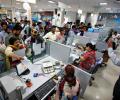
Public-sector banks, which are the largest employers in the banking space, have seen a drop in clerical staff over the years.

Budget 2015 has blessed the banking sector.

Billionaire Mukesh Ambani-promoted Reliance Industries Ltd (RIL) on Tuesday became the first listed company to hit the Rs 20 lakh crore market valuation mark. The market heavyweight's stock jumped 1.88 per cent to its record high of Rs 2,957.80 apiece on the BSE. It finally settled at Rs 2,928.95 per piece, up 0.90 per cent on the bourse.

ITC was the biggest loser from the Sensex pack, sliding 2.04 per cent, followed by Power Grid, Reliance Industries, Larsen & Toubro, Nestle, Kotak Mahindra Bank, Bajaj Finance and JSW Steel. On the other hand, Titan, State Bank of India, Bajaj Finserv, Axis Bank, Tata Steel, Sun Pharma, Tech Mahindra and Bharti Airtel were the gainers.

The continuing stress faced by corporate India has weakened their debt-servicing capability and this is reflected in the banks' books, as yet-burgeoning bad loans.

India's financial sector is dominated by large government-owned and private-sector banks.

Wipro was the biggest loser among Sensex firms, sliding 2.32 per cent, followed by HDFC Bank, Power Grid, UltraTech Cement, ITC, ICICI Bank and Tata Motors. IndusInd Bank, Maruti, State Bank of India, Mahindra & Mahindra, Asian Paints and Bajaj Finserv were among the gainers.

While rising interest rates and tighter liquidity are giving negative signals for the financial sector, increasing economic activity could mean higher business volumes for lenders. Liquidity in the banking system has moved from Rs 8 trillion surplus into a deficit of Rs 33,000 crore over the 2022 calendar year. By the end of November, bank credit had grown 17.5 per cent YoY (year-on-year).
.jpg)
Bank stocks have underperformed in the second quarter of FY'14 with the BSE Bankex declining 18 per cent compared to fall of 1 per cent in the BSE 30-stock index, Sensex, during this period.

'We may bite the bullet and draw up plans for privatisation.' 'If that is done now, the sale of the government stake will fetch money; a delay will see erosion in whatever value is left in these banks,' says Tamal Bandyopadhyay.

Seven of the 10 most valued domestic companies together added Rs 1,31,173.41 crore in market valuation last week, with HUL and TCS emerging as the biggest gainers. Reliance Industries, Infosys, HDFC, Bajaj Finance and Wipro also saw a rise in their market valuations, while HDFC Bank, ICICI Bank and SBI suffered losses. The market capitalisation (m-cap) of Hindustan Unilever Limited (HUL) zoomed Rs 50,234.21 crore to Rs 6,15,016.63 crore.
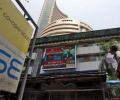
The market capitalisation of Reliance Industries plummeted by Rs 43,491.37 crore to reach Rs 17,26,714.05 crore.

YES Bank, Bank of Baroda, SBI, IndusInd Bank, and RBL Bank are amongst the banks, Jefferies says, are most prune to "high risk" emanating from ADAG, Cox & Kings, CG Power, DHFL and Essar Shipping.

Brokerages expect a further slowdown in Indian firms' revenue and earnings growth in Q4FY25, following low single-digit growth in the preceding three quarters, as factors like weak consumer demand and credit growth linger on.

'India's top companies currently lack the organisational wherewithal to hire and train 2 million interns annually, given their current scale of operations and existing employee base.'

From the Sensex firms, Wipro, NTPC, Sun Pharma, Mahindra & Mahindra, ITC and Reliance Industries were among the biggest laggards. IndusInd Bank, Axis Bank, Bajaj Finance, HDFC Bank, Larsen & Toubro and State Bank of India were among the major gainers.
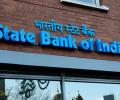
Be wary of co-operative banks which have historically been most vulnerable.

Host of lenders led by State Bank of India (SBI) and Bank of India hiked lending rates after the Reserve Bank raised the benchmark interest rate to tame inflation. The hike has been effected in their benchmark rate linked to the repo rate, which increased by half a percentage point to 5.9 per cent. Even financial institutions like mortgage lender HDFC Ltd hiked the lending rate by 50 basis points effective Saturday.

Global funds, according to Christopher Wood, global head of equity strategy at Jefferies, are now beginning to pay more attention to India with the market now offering 30 companies with a market capitalisation over $25 billion.
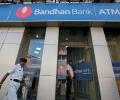
It is 10 years since Bandhan Financial Services became the first microfinance institution (MFI) to receive the universal bank licence. A year later, in 2015, it started operations. Bandhan's entry into banking was seen as a vote of confidence by the Reserve Bank of India (RBI) for the country's microfinance sector. Subsequently, the RBI awarded small finance bank licences to nine MFIs.

From the Sensex pack, Sun Pharma, Maruti, Tata Motors, ITC, Nestle, Larsen & Toubro, Infosys, Asian Paints, Titan, Tech Mahindra, Power Grid and Reliance Industries were the major gainers. Bajaj Finance, Axis Bank, HCL Technologies, State Bank of India, HDFC, HDFC Bank, ICICI Bank and Bajaj Finserv were among the laggard from the 30-share pack.

Benchmark BSE Sensex rallied over 350 points on Tuesday following gains in index majors HDFC twins, Bharti Airtel and Infosys amid a largely positive trend in global equity markets. The 30-share BSE barometer jumped 350.16 points or 0.61 per cent to settle at 57,943.65. During the day, it rallied 408.04 points or 0.70 per cent to 58,001.53. The broader NSE Nifty gained 103.30 points or 0.60 per cent to settle at 17,325.30.

Banks operating in India reported fraud of Rs 4.92 trillion as on March 31, 2021, which represents nearly 4.5 per cent of the total bank credit, showed Reserve Bank of India (RBI) data, which was sought under the Right to Information (RTI) Act by Saurabh Pandhare. The data showed 90 banks and financial institutions reported a total of 45,613 cases of loan fraud till March 31, 2021. State Bank of India - the country's largest lender - reported the highest amount of loans as fraud - Rs 78,072 crore as on March 31, 2021.

However, despite the reduction, their interest rates would be about 50-100 basis points higher than those of banks
Credit card spending has crossed Rs 1.13 lakh crore in May compared to Rs 1.05 lakh crore in the previous month according to official data. The month-on-month rise in spending through cards indicates a pick-up in economic activity. The latest data from the Reserve Bank of India (RBI) showed that 7.68 crore credit card holders spent about Rs 71,429 crore for buying online, while the amount was spent through swipes at Point of Sale (PoS) machines stood at Rs 42,266 crore in May.

From the Sensex basket, Larsen & Toubro, Maruti, Reliance Industries, Nestle, Bharti Airtel, UltraTech Cement, Kotak Mahindra Bank and JSW Steel were among the major laggards. Bajaj Finance climbed nearly 1 per cent higher.

Credit-to-deposit (CD) ratio of major public sector and private sector banks during the October-December quarter of FY24 inched up as compared to the previous quarter though government-owned lenders reported a lower rate than their private peers. CD ratio is the ratio of the funds that banks lend as compared to the funds raised in the form of deposits. The CD ratio of top public sector banks (PSBs) - State Bank of India, Punjab National Bank, Bank of Baroda and Canara Bank - was lower than their private counterparts.

After the finance minister directed public sector banks to join the account aggregator (AA) ecosystem, 5-6 major ones, including State Bank of India (SBI) and Bank of Baroda are expected to go live by July-end. Sahmati, an industry alliance for the AA ecosystem, has been working with PSU banks to get them onboarded for quite some time now. So far, Union Bank of India and Punjab National Bank (PNB) have gone live on the AA ecosystem. While Union Bank has been live for a while, PNB went live earlier this month.

From the Sensex pack, State Bank of India, IndusInd Bank, Bajaj Finserv, Tata Steel, ITC, Axis Bank, HDFC Bank, UltraTech Cement, NTPC and Tata Motors were the major winners. Nestle, Kotak Mahindra Bank, Bharti Airtel, HCL Technologies and Hindustan Unilever were the laggards.
 © 2026 Rediff.com - Advertise with us - Disclaimer - Privacy Policy - Sitemap - Feedback - About us - Terms of use - Grievances